Bed Slat Spacing: The Number Your Warranty Sets
· 10 min read
As an Amazon Associate we earn from qualifying purchases. Recommendations here are built from manufacturer specifications and what owners report. Links may earn us a commission; it changes nothing about what we recommend.
The binding number is in your mattress warranty, not your frame's instructions
Two inches. That's the maximum bed slat spacing one owner reports Beautyrest's warranty allows, and it's less than the 4 inches a retailer like European Sleep Works treats as an outer limit. So the number that binds you is the one printed in your mattress warranty, not the one in your frame's assembly leaflet. The same gap that keeps one mattress covered voids another. Nobody publishes a single correct number because there isn't one.
The spread is wider than most people realise. European Sleep Works tells buyers that real wood slats running the length of the bed should ideally sit under 3 inches apart and never exceed 4. Slat maker Yuantuo Wood skips the single figure entirely and sets it by mattress type: 2 to 3 inches for memory foam, 2.5 to 3.5 for latex, 3 to 4 for innerspring. Casper's own guidance acknowledges that gaps between slats can cause wear on certain mattresses, particularly all-foam models.
Yuantuo Wood notes that some mattress makers make spacing a condition of coverage. Your frame maker has no stake in that document. By the end of this piece you'll know which variables the available guidance says matter, and how to check whether the slats already under you are holding the mattress flat.
One case shows the gap between advice and contract. A queen innerspring owner was told by a mattress salesperson that 2.5 inches would be fine. The owner reported that Beautyrest's warranty required no more than 2. The salesperson wasn't lying about support. He just wasn't the one honouring the claim.
Quick answer
- The pick: Bed Slats Center, for a frame whose slats already sag in the middle because nothing is holding them up off the floor.
- Also worth it: Meliusly Queen, for someone whose existing frame has 4–5 inch slat gaps and needs to close them to under 2.5 inches without buying a new bed.
- How this was decided: published specifications and buyer reports across 12 products, compared below.
Four variables, not one figure
Spacing is only one term in the equation. Yuantuo Wood states that thicker, wider and hardwood slats tolerate wider spacing, while thinner slats need closer spacing.
The first term is thickness, and it works as a floor rather than a scale. European Sleep Works specifies slats that are flat, sturdy and non-flexible, in strong wood at least 3/4 inch thick. No source states how thinner stock performs at a given spacing, or what flex does to a foam core over time.
The second term is width, and it trades directly against gap. Yuantuo Wood sorts slats into classes: 1.5 to 2.5 inches is narrow, suited to memory foam or latex and to twin or full frames; above 3.5 inches is wide, typically reserved for queen, king and California king, heavier mattresses, or where maximum weight distribution is needed. Yuantuo Wood states that closer slat spacing generally calls for narrower slats, while wider spacing allows slightly wider ones.
No source pairs the two into a single table of gap figures by slat width, so any such rule would be the writer's invention rather than published guidance.
Third term: material. European Sleep Works advises against metal slats because they vibrate and flex more than wood. Yuantuo Wood says the opposite, that steel is strong enough to carry wider widths without losing support. The two claims are in direct conflict, and no source reconciles them.
Fourth: what the slat is meant to do. Casper draws the line clearly. Solid slats are flat and firm, sprung slats are gently curved and built to flex.
Where '3 inches or less' fails
A 190 lb side sleeper on the Mattress Underground forum photographed his own slats bending below the horizontal plane of the bed, under his hips and one shoulder. His gaps measured 2.5 inches. A salesperson had approved them. The stock was 1/4 inch thick and 2 1/4 inches wide, and it was sprung: curved on purpose to flex. Yuantuo Wood's innerspring range (3 to 4 inches) and European Sleep Works' limit (under 3, max 4) would both treat that spacing as acceptable.
The report does not establish whether the gap or the slat stock was at fault. No source states whether deflection under load is itself a defect, how much bend is too much, or at what weight a given spacing begins to fail.
Casper draws the distinction most buyers miss: solid slats are flat and firm, sprung slats are gently curved and meant to give. Sprung slats are not a defect.
The trouble is that it doesn't last. European Sleep Works warns that low-cost curved flexible slats lose their curvature over time, and once flattened they no longer support the frame as designed. That's why the firm recommends a sturdy flat slat instead. So a gap figure describes geometry only. It says nothing about whether the wood holding your hips will still be where it started in three years.
| Product | Size | Material | Item Weight | Color | Suits |
|---|---|---|---|---|---|
| Meliusly Queen | 79.92 x 60.24 x 0.6 inches | Engineered Wood | — | Natural Wood | Best gap fix |
| Meliusly Twin | 74.29 x 37.28 x 1.57 inches | Engineered Wood, Metal | 25 pounds | Natural Wood | Best for bunks |
| Handmade The Furniture Cove | — | — | — | — | Best custom cut |
| Dremdo | WxL:28x59in | — | — | One Color | Best tightest gaps |
| Boyd Sleep 14" | 74"L x 53"W x 14"H | Metal, Wood | 39 pounds | Black | Best adjustable feel |
| ZINUS Abel | 79.5"L x 59.5"W x 14"H | Alloy Steel | 37 pounds | Black | Best metal slats |
| Founasia | 80"L x 76"W x 18"H | Metal | 48 pounds | — | Best heavy duty |
| Mellow Naturalista Classic | 79.5"L x 59.5"W x 12"H | Wood | — | Natural Pine | Best all wood |
| Bed Slats Center | 49.5"L x 3"W x 9"H | Heavy duty steel (1" tubular) | 13 lbs. | Black | Best centre support |
| Amazon Basics | 81.6 x 59.7 x 8.3 inches | Metal | 39.2 pounds | Black | Best low profile |
| MAF 14 | 79.5"L x 59.5"W x 14"H | Metal, Wood | 53 pounds | Black | Best no side legs |
| ZINUS Moiz | 79.5"L x 59.5"W x 14"H | Alloy Steel, Wood | 48.5 pounds | Natural | Best wood steel mix |
Spec columns quote the listings verbatim. “Suits” is editorial.
Which one is yours
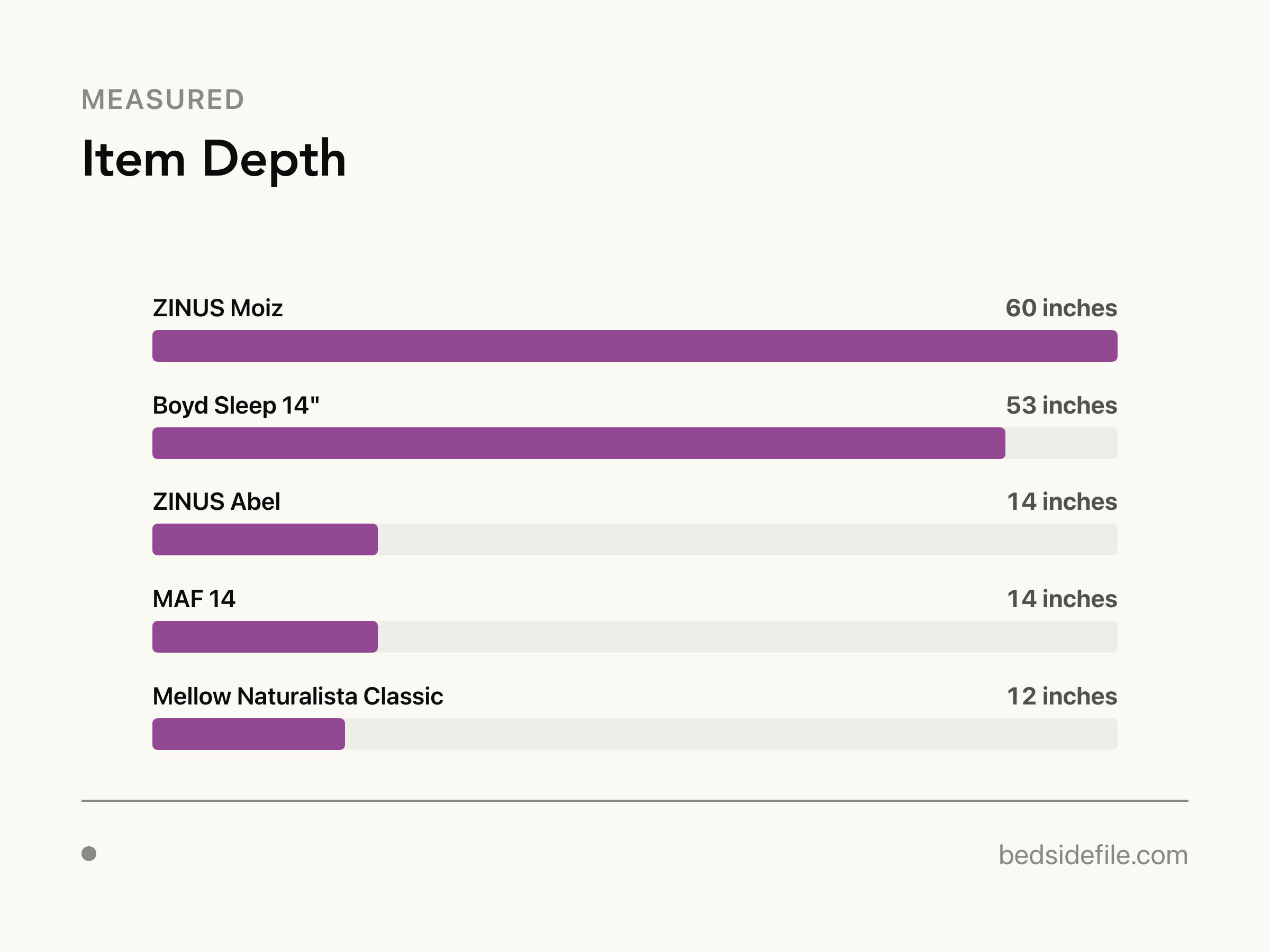
- Need item depth under 14 inches? → Meliusly Queen
- Around 14 inches is enough? → ZINUS Abel
- Need every bit of item depth you can get? → ZINUS Moiz
Set the gap by what's inside the mattress
Slat spacing depends on what's inside the mattress, because different constructions fail in different ways. Yuantuo Wood, which manufactures slats, sets three ranges instead of one figure: 2 to 3 inches for memory foam, 2.5 to 3.5 inches for latex, 3 to 4 inches for innerspring.
Yuantuo Wood states that body-conforming memory foam and latex mattresses need narrower slats set closer together, in a 'zero-gap' or 'close-set' arrangement, to keep the mattress from sinking between slats. Casper acknowledges that gaps can cause wear, particularly on all-foam models. Neither source describes what actually fails, or over what timescale.
Yuantuo Wood sets a wider range for innerspring (3 to 4 inches) than for foam or latex, but does not say why.
Latex sits between the two. Yuantuo puts its upper limit at 3.5 inches, against 3 for memory foam, without stating a reason. Yuantuo also links width to construction, classing slats of 1.5 to 2.5 inches as narrow and suited to foam or latex.
Three checks on the bed you already own
A tape measure tells you the gap and nothing else. These three checks tell you whether the frame under you is actually holding the mattress flat,.
- Sight along the slat tops under load. Get your eye down at slat level at the foot of the bed, mattress off, and have someone lie across the middle at hip height. Look for any slat that drops below the horizontal plane its neighbours form. The forum report treated slats bending below the horizontal plane as the sign of trouble, though that was the sleeper's own judgment rather than a stated standard.
- Stand in the middle, then sit on the edges. European Sleep Works gives the test plainly: on a sound platform frame you can stand in the centre with no flexing, and sit on either side with no flexing. European Sleep Works notes that mattresses get blamed for sagging when absent or inadequate centre legs are the real cause.
- Check whether sprung slats still curve. Sprung slats are built with a deliberate arch, and that curvature flattens with wear until the slat no longer supports as designed. European Sleep Works warns that low-cost curved flexible slats lose their curvature over time and compromise the frame's support once flattened.
- Check the centre legs. European Sleep Works specifies a centre rail with 3 evenly spaced legs including one in the middle, fitting snugly to the floor with no downward movement, or one leg if the rail is attached at head and foot of the frame.
Fixes that work, and fixes that trade one problem for another
The evidence covers only one retrofit route, a plywood or pegboard deck over narrow slats, and centre-leg support. No source addresses what else to do about an existing bed whose gaps are too wide.
Closing gaps on a sound frame. The evidence file contains no product specifications for bunkie boards, roll-up slat panels or custom-cut slats, so no such product can be recommended or compared here.
Plywood is the fix that trades problems. Mattress Foam Company advises that when slats are narrower than the gaps between them, a plywood or pegboard layer be added on top of the slats for the mattress warranty to stay valid. Its drilling spec runs like this:
- holes of 3/8 to 3/4 inch, lined up with the spaces between slats
- roughly 3/8 inch holes set 4 to 6 inches apart
- 50 to 100 holes for a queen
- the deck run to the full length and width of the mattress, not stopping short of the rails
So does the plywood suffocate the mattress?
European Sleep Works does not recommend plywood as a slat substitute unless the ply is at least 1 inch thick, and notes that a solid plywood deck reduces airflow, raising sleep temperatures and the chance of mold. Whether the drilled holes restore enough airflow to offset that is untested by either source.
Sagging middle, correct spacing. European Sleep Works says mattresses are often blamed for sagging when the real cause is inadequate or nonexistent centre legs, and specifies a centre rail carrying three evenly spaced legs down to the floor with no downward movement. Yuantuo Wood recommends a centre support rail for queen, king and California king beds. The evidence file contains no specifications for any centre-support product.
Replacing the frame. Yuantuo Wood classes slats above 3.5 inches as wide and reserves them for queen, king and California king, heavier mattresses, or where maximum weight distribution is needed. The evidence file contains no specifications for particular bed frames, so no model can be assessed here.
Two inches, three, or four. Where a mattress maker sets spacing as a condition of coverage, that number binds regardless of what the frame's leaflet says, though no source states how to find your own mattress's requirement, or which brands publish one.
What to buy
Bed Slats Center, best for a frame whose slats already sag in the middle because nothing is holding them up off the floor.
If your case is different:
- For someone whose existing frame has 4–5 inch slat gaps and needs to close them to under 2.5 inches without buying a new bed: Meliusly Queen.
- For a bunk or loft bed where the mattress support has to drop inside the rails and take real abuse without bowing: Meliusly Twin.
- For a reader who wants pine slats cut to their own measurements and can accept a wider 2.5 inch gap: Handmade The Furniture Cove.
One caveat on the Bed Slats Center: does not change slat spacing at all, only underpins it
Questions
What is the gap between bed slats supposed to be?
There is no single figure. European Sleep Works says wood slats should ideally sit under 3 inches apart and never exceed 4. Slat maker Yuantuo Wood sets it by mattress type: 2 to 3 inches for memory foam, 2.5 to 3.5 for latex, 3 to 4 for innerspring. Your mattress warranty may demand less.
Can slat spacing void my mattress warranty?
Yes. Yuantuo Wood notes some mattress makers make spacing a condition of coverage. One queen owner reported Beautyrest's warranty allowed no more than 2 inches, even though a salesperson approved 2.5. Your frame maker has no stake in that document, so the warranty figure is the one that binds you.
Do memory foam mattresses need closer slats than innerspring?
Yes. Yuantuo Wood sets 2 to 3 inches for memory foam against 3 to 4 for innerspring, and recommends narrower slats set close together, or zero-gap, so body-conforming foam does not sink between them. Casper also acknowledges gaps can cause wear, particularly on all-foam models.
How do I know if my bed slats are too far apart?
Take the mattress off, get your eye down at slat level and have someone lie across the middle at hip height. Watch for any slat dropping below the horizontal plane its neighbours form. Also stand in the centre and sit on each edge: a sound platform frame should not flex.
Sources
- Bed Slat spacing for best support and ventilation - MFC Canada - Mattress Underground accessed 2026-08-04
- Platform Bed Frame Guide - European Sleep Works accessed 2026-08-04
- Perfect Bed Slat Spacing: 5 Secrets to Sag-Free Sleep! accessed 2026-08-04
- 7 Key Factors: Optimal Bed Slat Width for a Cozy Sleep accessed 2026-08-04
- Slats vs Solid Bed Base: Differences & What's Best for You | Casper accessed 2026-08-04