Bedside Lamp Brightness: Two Numbers, Not One
· 9 min read
As an Amazon Associate we earn from qualifying purchases. Recommendations here are built from manufacturer specifications and what owners report. Links may earn us a commission; it changes nothing about what we recommend.
Why published lumen advice for bedside lamps contradicts itself
You search for a number and get four.
Sorting the figures by job narrows the spread. The ambient recommendations in these guides run from roughly 200 to 470 lumens; the one dedicated reading figure, Seus Lighting's, starts at 800 lumens. Seus Lighting's own reading band is three to six times what it recommends for general bedside light. Whether every published figure is really one of those two jobs wearing a generic label is not something any of these sources states.
That's the shape of the problem. One guide says 450 lumens or lower. Another says 200 to 400. A third says 800 to 1,200 for the same spot on the same nightstand. If you're trying to pin down bedside lamp brightness before buying a bulb, the spread looks like nobody knows. It may be that they are answering two different questions and only labelling one of them.
What's at stake is a purchase you can't undo cheaply: a lamp specced for mood may not give you enough light for a paperback, and one specced for task light with no dimmer offers no way down. By the end of this you'll know which of the two numbers applies to you, and whether one dimmable lamp can honestly carry both.
Here's what the published figures actually say, once you sort them by job rather than by publisher:
Read across the Seus Lighting row and the clearest gap appears: 200-400 against 800-1,200, same lamp position, different task.
Nordic Nest contradicts itself in one page. Its tier table gives functional lighting as 806-1,520 lumens. Elsewhere on the same page it advises that a bulb for "functional or general" lighting should preferably be 400-806 lumens. Those two statements don't overlap at all. The correct figure is left unresolved.
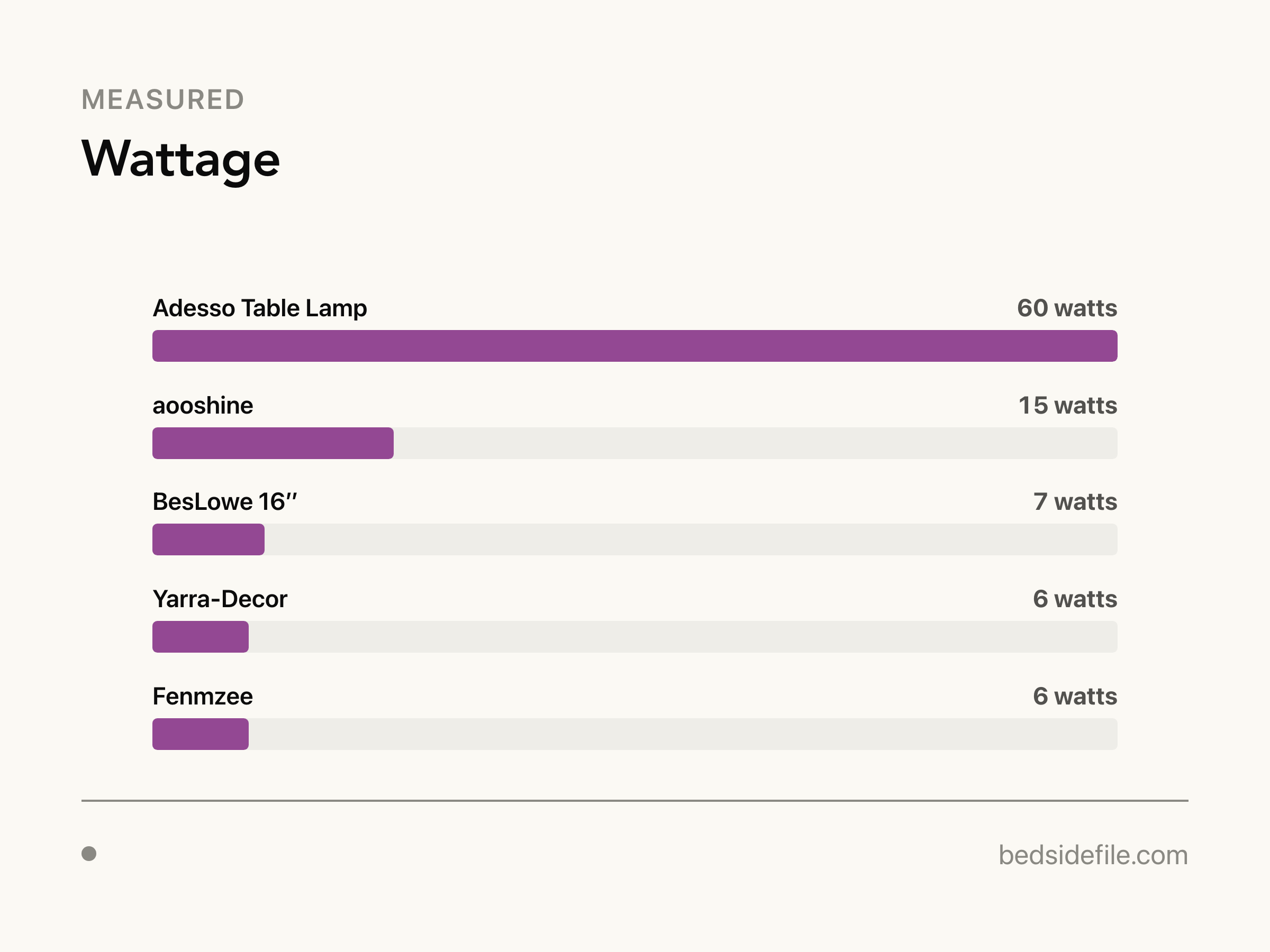
One more thing worth clearing up: lumens measure brightness, watts measure energy use. Watts are routinely mistaken for brightness.
Quick answer
- The pick: Yarra-Decor, for anyone who wants to swing between a dim nightlight and a brighter reading level without getting out of bed, and charge a phone from the same plug.
- Also worth it: Adesso Table Lamp, for a reader who wants to set the brightness themselves by choosing the bulb, in a lamp whose linen shade diffuses light rather than dimming it.
- How this was decided: published specifications and buyer reports across 8 products, compared below.
Spec the lamp from its top end, not its middle
Dimming only ever subtracts.
Seus Lighting's spec for general bedside illumination is 200 to 400 lumens paired with dimmable control, on the reasoning that dimming covers everything from reading-bright down to relaxation. Seus Lighting does not say how its 200-400 lumen ambient band relates to its own 800-1,200 lumen reading figure.
Whether one dimmable lamp can cover both jobs is not resolved by any of these guides: none gives a dimming range as a ratio or a minimum output at the lowest setting, so there is no published basis for calculating what a given lamp delivers when dimmed.
Two things follow from that:
- For lamps sold without bulbs, no source states what bulb wattage or lumen output the shade was designed for.
- Integrated LEDs can't be swapped. Wirecutter notes the HAY Matin's LED can't be swapped, and the Strategist puts its output at 220 lumens.
Is 150 lumens too dim? None of these guides specifies a figure that low: the lowest published band here is Seus Lighting's 200-400 lumens for general bedside light and Nordic Nest's 220-360 for mood lighting.
For any lamp sold without a bulb, the brightness depends entirely on what the buyer supplies. Wirecutter notes this of the West Elm Mooney, whose E26 socket ships empty.
| Product | Product Dimensions | Wattage | Bulb Base | Bulb Shape Size | Suits |
|---|---|---|---|---|---|
| Yarra-Decor | 5.5"D x 5.5"W x 15"H | 6 watts | E26 | A19 | Best dimmable control |
| Adesso Table Lamp | 9"D x 9"W x 17"H | 60 watts | E26 Medium | A19 | Best bulb flexibility |
| Bulbrite | — | 5 watts | E26 | B11 | Best ambient bulb |
| Fenmzee | 4.45"D x 4.45"W x 14"H | 6 watts | E26 | A19 | Best for small nightstands |
| BesLowe 16’’ | 0.1"D x 11"W x 16.1"H | 7 watts | E26 Medium | A19 | Best all-round dimmable |
| aooshine | 4.1"D x 4.1"W x 12.8"H | 15 watts | E26 | A19 | Best space-saving |
| BRILLRAYDO | — | 3 W | — | — | Best pure ambient |
| 503 - Service Unavailable Error | — | — | — | — | Best fine dimming |
Spec columns quote the listings verbatim. “Suits” is editorial.
Which one is yours
- Need shade height under 12 inches? → Fenmzee
- Around 12 inches is enough? → Yarra-Decor
- Need every bit of shade height you can get? → Adesso Table Lamp
Three things that change page brightness more than the bulb does
None of these guides gives a lumen figure measured at the pillow or at the eye, and none explains how shade material, opacity or lamp height translates bulb lumens into what reaches a reader's face. What they do address separately is shade, height and dimming.
- Shade geometry decides where the light goes. Wirecutter notes that the Crate & Barrel Clem Light's solid metal shade sends all light downward, while it credits the West Elm Asymmetry's linen shade with dispersing light in a nice glow. Wirecutter's bedside guide exists because its author bought a lamp whose shade exposed too much bulb and sent a searing beam across the pillows, regardless of the bulb's rated output.
- Wirecutter treats the shade as a pass/fail criterion. Wirecutter judges a shade partly on whether it prevents overt hot spots where too much light peeks through, and requires that it efficiently diffuse or redirect the light. Outlight argues glare control matters more than raw brightness at the bedside, because the lamp is viewed from close range.
- Height sets whether the bulb is in your eyeline. Seus Lighting puts optimal bedside lamp height at 22 to 27 inches, with the bottom of the shade at eye level when you're sitting up in bed. True Design House makes the inverse rule explicit: tall lamp on a short table, shorter lamp on a tall one, and notes that a lamp set too high or too low can blind the user.
- Colour temperature advice is not settled at the top of the warm range. Seus Lighting recommends 2700K-3000K and says to avoid 4000K and cooler; Nordic Nest calls 4000K cold and blue in a home. Outlight's four 2026 picks run 3000K to 3500K (Vea and Blair at 3000K, Elm and Fenn at 3500K), and only the Vea dims, by touch. No source says whether 3500K is acceptable at the bedside.
Reading while someone else sleeps
Nordic Nest recommends building a cosy atmosphere from several lower-lumen lamps lit at once rather than one bright source. Beyond that, none of these sources covers two lamps on opposite sides of a bed, independent control for two sleepers, or what brightness works when one partner reads and the other sleeps.
Interior designer Liz Lipkin told the Strategist that adjustable, directional bedside lighting is what keeps a bed-sharing partner from being disturbed by a reader's light. True Design House makes the same case from the hardware side, recommending an adjustable arm and a shade that throws light onto the book rather than through the fabric. Nordic Nest goes further on the room as a whole: build the level from several lower-output lamps lit together rather than one bright source, and match colour temperature across them so the mix doesn't read as patchy.
Neither source gives a brightness figure for the shared-bed case.
Which of these eight suits which case
None of these eight lamps was switched on for this article. Everything below comes from manufacturer listings, none of which is in the evidence base for this article. Wirecutter's December 3, 2025 guide is the closest thing to a hands-on benchmark in this category: three weeks of research across hundreds of lamps from 28 companies, then 15 models slept beside for three to four nights each. This is not that. It's a comparison of what the makers publish.
No source here publishes lumen output for these lamps, and no source gives a wattage-to-lumen conversion.
If you need genuine reading light: the evidence base here contains no lamp with a documented output in Seus Lighting's 800-1,200 lumen reading band. Among the lamps it does cover, the West Elm Asymmetry (17-inch, $149) and the West Elm Mooney ($159) both take an E26 bulb that is not included, so their output depends entirely on what the buyer supplies. Neither has a dimmer, only an in-line on/off switch.
If you want stepped brightness: Wirecutter's top pick, the $599 Room & Board Rayas, offers three levels from a high equivalent to a 100-watt incandescent down to a 280-lumen glow, comparable to a 30-watt bulb. The Strategist's top overall pick, the $245-and-up Hay Matin, emits 220 lumens and cycles three preset levels via a click button. Wirecutter notes its in-line touch dimmer runs highest to lowest, the wrong order for owners who wake in the night.
Size and bulbs
On footprint: of the lamps covered here, Wirecutter gives the West Elm Mooney as 12 by 12½ inches on an 8-inch base, and the West Elm Asymmetry as a 17-by-10-inch body.
If you are installing your own bulb: the Strategist tells buyers to look for roughly 450 lumens or lower, while Seus Lighting puts the target at 200-400 lumens of warm white 2700K-3000K light. The two are never reconciled.
Of the lamps documented here, only the Hay Matin's integrated LED is confirmed as non-replaceable; Wirecutter's manual cites 25,000 hours, or eight to 10 years of regular use.
So: four numbers, and no source that reconciles them. The Strategist's 450-lumen ceiling and Seus Lighting's 200-400 band are offered for general bedside light, Seus Lighting's 800-1,200 for directional reading light. But none of these pages states on what evidence any of the figures rests, and Seus Lighting warns elsewhere that bright light before bed disrupts sleep without saying whether a reading-bright bedside lamp defeats the purpose.
What to buy
Yarra-Decor, best for anyone who wants to swing between a dim nightlight and a brighter reading level without getting out of bed, and charge a phone from the same plug.
If your case is different:
- For a reader who wants to set the brightness themselves by choosing the bulb, in a lamp whose linen shade diffuses light rather than dimming it: Adesso Table Lamp.
- For someone whose existing bedside lamp is too bright and wants a low-lumen, warm, dimmable bulb for ambient light instead of reading: Bulbrite.
- For a narrow nightstand where the lamp has to stay slim but still charge a phone, tablet and one more device at once: Fenmzee.
One caveat on the Yarra-Decor: brightness is limited to three fixed steps rather than continuous dimming
Questions
How many lumens for a bedside lamp?
It depends on the job. Published guides put general or ambient bedside light at roughly 200-450 lumens: Seus Lighting says 200-400, the Strategist caps a self-installed bulb at 450. For directional reading light, Seus Lighting recommends 800-1,200 lumens, three to six times higher.
Is 150 lumens too dim for a bedside lamp?
No published guide in this comparison specifies a figure that low. The lowest bands are Seus Lighting's 200-400 lumens for general bedside light and Nordic Nest's 220-360 lumens for mood lighting. At 150 lumens you are below every published ambient recommendation, and far below any reading figure.
Why do lumen recommendations for bedside lamps vary so much?
Because guides answer two different questions and label only one. Ambient figures cluster around 200-470 lumens while the dedicated reading figure starts at 800. Nordic Nest even contradicts itself on one page, giving functional lighting as both 806-1,520 and 400-806 lumens without resolving which applies.
Can one dimmable lamp work for both reading and ambient light?
Spec it from the top end, because dimming only subtracts. Seus Lighting pairs its 200-400 lumen band with dimmable control, but no source publishes a dimming ratio or minimum output, so there is no basis for calculating what a lamp delivers at its lowest setting.
Does the lampshade change how bright a bedside lamp is?
Yes, in effect. Shade geometry decides where light goes: a solid metal shade throws it all downward, linen disperses it as glow. Wirecutter treats hot spots and poor diffusion as pass/fail, and Outlight argues glare control matters more than raw lumens at close bedside range.
Sources
- 23 Best Bedside Lights | The Strategist accessed 2026-08-04
- Best Table Lamps for Bedrooms: 4 Warm Picks for 2026 – Outlight accessed 2026-08-04
- The 10 Best Table Lamps of 2026 | Reviews by Wirecutter Advertisement accessed 2026-08-04
- Best Bedside Lamps: 12 Buying Tips & Top Styles accessed 2026-08-04
- Our 8 Favorite Bedside Lamps of 2026 | Reviews by Wirecutter Advertisement accessed 2026-08-04
- Choosing the right light bulb - colour temperature & lumen FAST WORLDWIDE SHIPPING accessed 2026-08-04
- Our 8 Favorite Bedside Lamps of 2026 | Reviews by Wirecutter Advertisement accessed 2026-08-04
- The Ultimate Bedside Lighting Guide — True Design House accessed 2026-08-04