Wardrobe Depth: Start From the Hanger, Not the Wall
· 10 min read
As an Amazon Associate we earn from qualifying purchases. Recommendations here are built from manufacturer specifications and what owners report. Links may earn us a commission; it changes nothing about what we recommend.
Add the hanger up, don't look it up
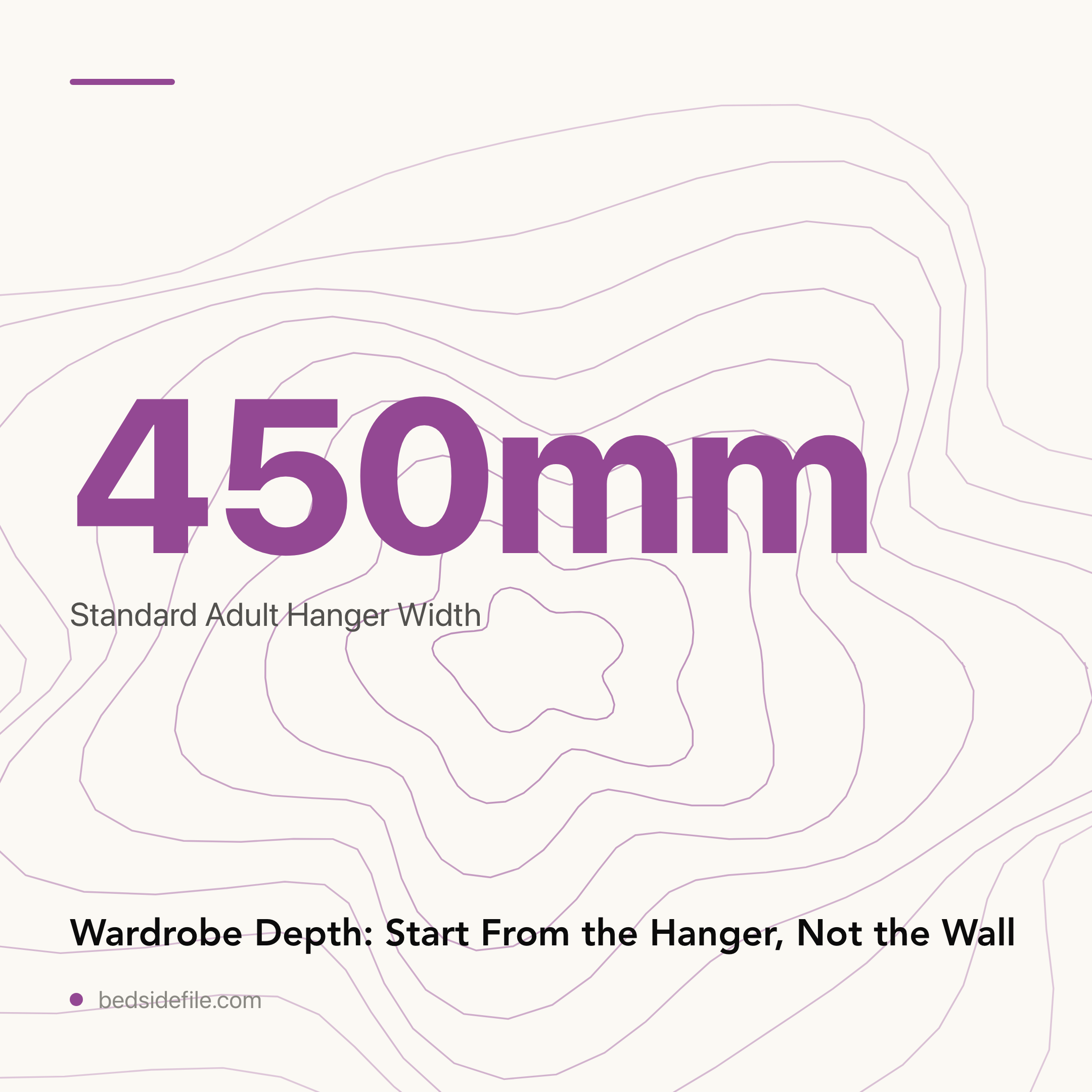
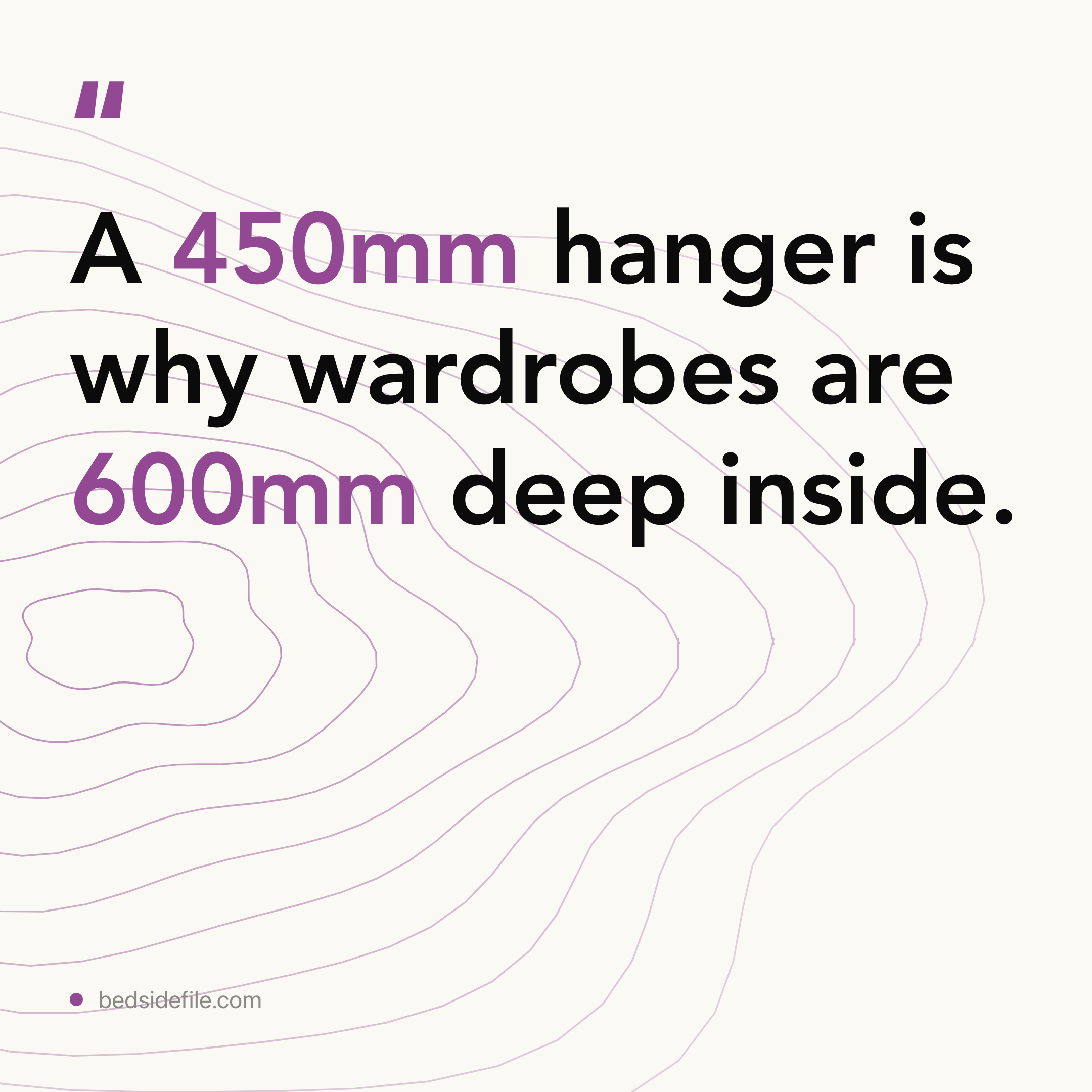
Measure the widest hanger you own, add the bulk of the coat that hangs on it, then add clearance front and back. That sum is your wardrobe depth, and for most adults it lands at 600mm, not because 600 is standard, but because a wooden hanger is about 450mm across the shoulders and everything else stacks on top of it.
Here's the arithmetic nobody publishes. Aussiecut puts a standard adult hanger at roughly 450mm wide, and that measure is the whole reason 600mm exists as a figure. Set the rail so its centreline sits 300–320mm off the back panel, as Joyce Kitchens specifies. No source states the clearance needed behind and in front of the rail at that setting.
Where the 600mm goes
- Hanger shoulder span, wooden or moulded: about 450mm, sitting across the rail, per Aussie Cut
No source turns that hanger width into a depth budget: garment bulk on the shoulder, rear clearance behind the sleeve and front clearance to the door are nowhere quantified. No source quantifies how a 550mm box behaves with different hangers or garments, or how far a shoulder protrudes at 550mm versus 600mm. FCI London draws the line more bluntly: 60cm for hinged doors, 55cm only where you don't intend to hang anything at all.
This is a comparison of six freestanding units against that arithmetic, built from published specifications rather than anything measured in a room. If you rent, or your alcove is 18 inches deep, or you're fitting out a child's room where Aussie Cut notes 450–500mm works because children's clothes are smaller and less bulky, the number you need is not the number in the standard.
Quick answer
- The pick: Letaya Armoire, for someone with no built-in closet who needs a freestanding unit deep enough that hangers sit square and the doors still shut over them.
- Also worth it: Hencawima 4-Tier Stackable, for someone working inside a shallow closet where a 12-inch-deep stack is the only thing that will sit flush without blocking the door or the hanging rail.
- How this was decided: published specifications and buyer reports across 6 products, compared below.
Why 18 inches, 600mm and 670mm are all correct
Three numbers dominate the published advice on wardrobe depth, and it is not always possible to tell whether they measure the same thing. Livspace's design guide gives 1.5ft, 18 inches, as standard, describing it as enough for folded clothes and recommending 2ft only for hanging coats, blazers, heavy dresses or saris. Joyce Kitchens gives 600mm as the Australian standard, and specifies it as internal depth: the clear space behind the door. FCI London puts the ideal standard depth at about 67cm and says anything under 60cm rules out standard horizontal hanging rails; it does not state whether that figure includes doors.
Only My Sliding Wardrobe (58–60cm overall) and Joyce Kitchens (600mm internal) say which basis their figures use, so the three numbers cannot be reconciled from the published sources.
Where the missing millimetres go
So where does the difference go?
Into the door. You can see the arithmetic close in Joyce Kitchens' own figures: it puts hinged built-ins at 620–640mm overall once door thickness is added to that 600mm internal measure. Twenty to forty millimetres for a door leaf. FCI London's reference table sets hinged-door depth at 550mm minimum, 600mm recommended and 650–680mm for its luxury range, though the source does not state whether those are internal or overall figures.
What sliding doors cost in depth
The sliding deduction
Sliding doors are usually sold as the space-efficient choice. Livspace puts hinged swing-door clearance at 300mm, while Asian Paints says hinged doors need front clearance at least equal to the door width, comfortably 30–36 inches. In depth terms, though, sliding costs you. Both FCI London and Aussie Cut specify 66cm plus about 5cm for the running track. Asian Paints Beautiful Homes puts standard track depth at 1–1.5 inches top and 0.5–1 inch bottom, with 1–2 inches of panel overlap per panel, so sliding needs 2–4 inches more depth than a swing model for the same interior.
My Sliding Wardrobe warns that 54cm works but is snug for standard hangers, and that 54cm–58cm sits below the average sliding depth. No source publishes the clear internal depth left once track and panel are deducted from a given sliding carcase, so the two door types cannot be compared on that basis from these figures.
Depth by garment: what you actually own
No source gives per-garment depth requirements for a shirt or a parka, but the spread between light and bulky garments is why a single wardrobe depth figure fails anyone whose wardrobe leans heavily one way.
Work down the list of what you actually own. Suit jackets and tailored blazers are the point where the generic 600mm starts to strain: Aussie Cut puts suits and evening gowns at 65cm minimum to avoid wrinkling, and 70cm or more for high-end collections you want hanging free with air flow. Saris fall into the same bracket. The Indian design guide from Livspace treats 1.5ft as fine for folded clothes and reserves 2ft specifically for coats, blazers, heavy dresses and saris. No source addresses depth for bridal gowns or other outsized garments.
Then there's the upper limit. Aussie Cut is blunt about it: past 75cm, depth starts working against you. Small rooms feel cramped and whatever is at the back becomes something you stop reaching for. Aussie Cut says deeper built-ins of 650–700mm are commonly chosen when internal drawers or bulky items are involved; it puts drawers at 450–500mm deep, and Joyce Kitchens sets top shelf depth at 400–500mm, deeper for bulky bedding. No source states the carcass depth required by specific pull-out fittings.
| Product | Product Dimensions | Material | Item Weight | Color | Suits |
|---|---|---|---|---|---|
| Letaya Armoire | — | Metal frame with resin panels | — | — | Best full-depth wardrobe |
| Hencawima 4-Tier Stackable | 12.20 inches x 12.00 inches x 12.20 inches | Metal, Wood | 14 pounds | Black | Best shallow-closet fit |
| MAGINELS | — | PP plastic panels with steel frame | — | — | Best shallow footprint |
| Honey Can Do 60-Inch | 60-Inch Wide 2-Door | Steel frame with non-woven fabric cover | 11.6 pounds | Grey | Best wide rail |
| Dpofirs | — | Steel tube frame with fabric cover | — | — | Best mixed storage |
| MOGELAFOO 35“ | 34.6 x 17.7 x 65.7 inches | — | 7 pounds | Black | Best for renters |
Spec columns quote the listings verbatim. “Suits” is editorial.
Which one is yours
- Need item weight under 11.6 pounds? → MOGELAFOO 35“
- Around 11.6 pounds is enough? → Honey Can Do 60-Inch
- Need every bit of item weight you can get? → Hencawima 4-Tier Stackable
Four symptoms that tell you the box is too shallow
No source measures the consequence of going under-depth. Creasing, catching on doors and "snug" fit are asserted in the published guides, but nothing quantifies at what depth each appears, so the symptoms below cannot be tied to specific depths.
- Creasing. Aussie Cut says suits and evening gowns need at least 65cm of depth to avoid wrinkling.
- A snug fit for standard hangers. My Sliding Wardrobe says 54cm works but is snug, and that 54cm–58cm is below the average sliding depth.
- Clothes catching on or protruding past the doors. Aussie Cut gives this as the reason 600mm of depth is needed, since standard adult hangers are about 450mm wide.
No source states how much a shoulder protrudes at 550mm versus 600mm, or how these thresholds shift with padded or wooden hangers.
Below 500mm, and the depth that vanishes on install day
No source addresses depth for pull-out internal fittings such as front-to-back hanging rails, or the runner and carcass depth they require, so there is no sourced answer for an alcove under 500mm.
My Sliding Wardrobe's own depth guide shows what happens at the shallow end: at 18cm depth, horizontal casing boards can be added behind sliding doors to act as narrow shelves, and the absolute minimum for sliding doors and track alone is 8.3cm without casing, 9cm with. No source describes a hanging solution at those depths.
The second thing that goes wrong is arithmetic. No source gives tolerances for out-of-plumb walls, uneven floors or scribing, but several factors are specified individually:
- 16mm back panel. Joyce Kitchens specifies 16–18mm HMR white melamine carcasses with 16mm back panels for rigidity, and plywood for premium builds; Livspace, by contrast, recommends MDF over plywood, arguing plywood tends to cave after a certain time
- 3–5 inches from the floor for skirting boards, per Beautiful Homes, which also advises 2–4 inches from the ceiling for coving or cornice
- drawers, which Aussie Cut says work best at 450–500mm deep
My Sliding Wardrobe advises allowing the interior depth plus 9cm for doors, track and casing.
Letaya Armoire — Best full-depth wardrobe
- 20 in. depth is the practical minimum for a hanger to hang square
- Rigid panels hold the depth instead of bowing
- But: 20 in. leaves almost no clearance for padded or wooden hangers
- But: Metal shelf edges are unfinished in places
Hencawima 4-Tier Stackable — Best shallow-closet fit
- Uses the dead depth behind a shallow rail rather than wasting it
- Front openings mean you do not unstack to reach the bottom
- But: Only useful in a wardrobe deep enough to have leftover space
- But: Plastic baskets flex when loaded with heavy knitwear
MAGINELS — Best shallow footprint
- Shallow 18 in. depth suits a narrow hallway or alcove
- Modular cubes can be reconfigured into different footprints
- But: 18 in. depth is too shallow for shoulders on adult coat hangers to sit square
- But: Plastic connectors flex under heavy loads
Honey Can Do 60-Inch — Best wide rail
- 60 in. width gives a long unbroken rail for shirts
- Zip doors keep dust off shoulders
- But: Fabric sides bow outward, so usable depth is less than the stated depth
- But: No fixed shelf above the rail
Dpofirs — Best mixed storage
- Splits into a hanging bay and a shelf stack so shallow shelves absorb the leftover depth
- Roll-up doors need no swing clearance
- But: Fabric shell sags between uprights over a full rail
- But: Shelf sections reduce hanging width
MOGELAFOO 35“ — Best for renters
- 18 in. depth in a 35 in. wide, 66 in. tall frame that fits shallow alcoves and dorm walls
- Two movable hanging rods plus four shelves split hanging and folded storage
- But: 18 in. depth is shallower than a standard 20–24 in. closet, so wide-shouldered coats may press the cover
- But: Fabric-and-tube construction offers no rigid shell and no stated rod weight limit
Which freestanding unit suits which depth problem
The evidence file contains no product specifications for freestanding wardrobe units, so no comparison of named models, their depths or their listed caveats can be sourced here.
Aussie Cut's 450mm standard hanger width remains the stated reason 600mm of depth stops clothes catching on or protruding past the doors. Aussie Cut's warning holds at the other end: beyond 75cm, small rooms feel cramped and items at the back become hard to reach. Measure your widest hanger before you measure the wall.
What to buy
Letaya Armoire, best for someone with no built-in closet who needs a freestanding unit deep enough that hangers sit square and the doors still shut over them.
If your case is different:
- For someone working inside a shallow closet where a 12-inch-deep stack is the only thing that will sit flush without blocking the door or the hanging rail: Hencawima 4-Tier Stackable.
- For you have a corridor or alcove barely 18 in. deep and need folded storage rather than a true hanging rail: MAGINELS.
- For you want maximum rail length in a spare room and can accept a fabric shell rather than rigid panels: Honey Can Do 60-Inch.
One caveat on the Letaya Armoire: 20 in. leaves almost no clearance for padded or wooden hangers
Questions
What is the minimum wardrobe depth for hanging clothes?
A standard adult hanger spans roughly 450mm across the shoulders, which is why 600mm internal depth is widely recommended so clothes don't catch on or protrude past the doors. FCI London gives 550mm as a hinged-door minimum and says 55cm suits only wardrobes where nothing will hang.
Do sliding wardrobes need to be deeper than hinged ones?
Yes, in depth terms. FCI London and Aussie Cut both specify about 66cm plus roughly 5cm for the running track. Asian Paints puts track depth at 1-1.5 inches top and 0.5-1 inch bottom, with 1-2 inches of panel overlap, so sliding needs 2-4 inches more depth than hinged.
What wardrobe depth do I need for coats and suit jackets?
Aussie Cut puts suits and evening gowns at 65cm minimum to avoid wrinkling, rising to 70cm or more for collections you want hanging free with airflow. Livspace treats 1.5ft as adequate for folded clothes and reserves 2ft for coats, blazers, heavy dresses and saris. Past 75cm, depth works against you.
Sources
- Standard Wardrobe Depth: A Practical Guide for Your Next Fit-Out accessed 2026-08-04
- What's the Best Way to Design a Wardrobe? Expert Wardrobe Design Tips accessed 2026-08-04
- Standard Wardrobe Dimensions Guide: Sizes, Depth & Layout | Beautiful Homes accessed 2026-08-04
- Wardrobe Depth Standards: What You Need to Know accessed 2026-08-04
- Standard Wardrobe Depth in Australia: Sizes, Layouts, Materials and Costs | Joyce Kitchens accessed 2026-08-04
- Never miss a post from houmeindia Sign up for Instagram to stay in the loop. accessed 2026-08-04
- Wardobe Depth Guide | Everything You Need to Know For Measuring up accessed 2026-08-04